
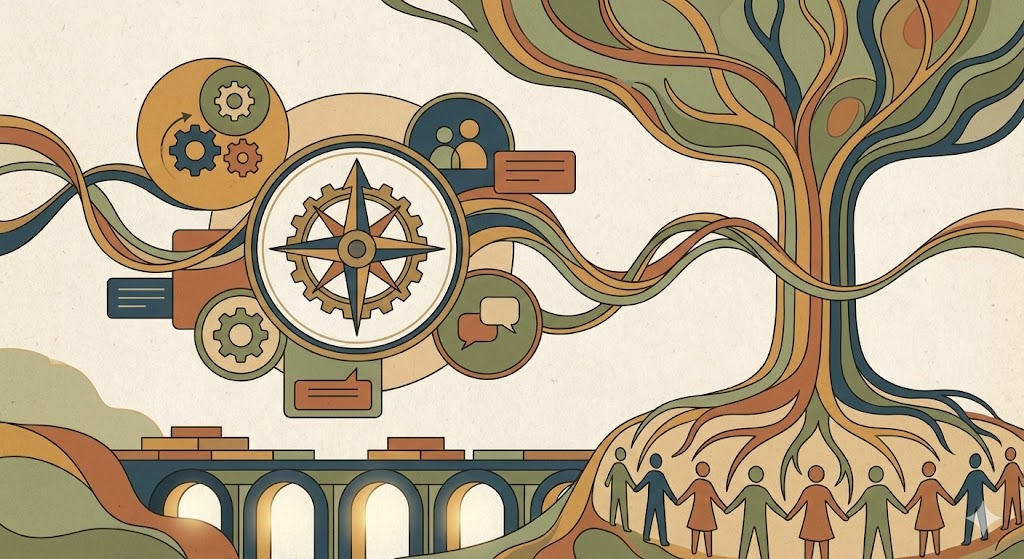
Enhancing Impact Through Strategic Innovation
Strong systems don’t have to look like bureaucracy, hierarchy, or rigid rules. For community-rooted organizations, systems are simply shared agreements—ways of working that protect our time, honor our values, and deepen our collective impact. When we build systems thoughtfully, we create the conditions for people to thrive, not just “perform.”
For movement organizations and community-centered institutions, systems design is really about building structures that help us organize our power and thrive together—not structures that maintain control. As such, the goal is not efficiency for efficiency’s sake. Rather, it is sustainability, clarity, and the ability to move in alignment with our purpose while optimizing the use of resources.
Systems grounded in political clarity, accountability to those most impacted, and practices that preserve wellbeing, become tools for liberation—not barriers to it.
What Values-Aligned Systems Make Possible
Systems that reflect the mission make our organizations easier to navigate. We reduce burnout, build continuity through leadership shifts, and don’t lose momentum every time someone transitions out. And we create pathways for people closest to the work—not just those with institutional knowledge—to lead.
With that, effective systems help nonprofits build community partnerships through:
- Making decisions transparently
- Sharing responsibility instead of concentrating power
- Preventing crises caused by disorganization
- Staying focused on long-term strategy rather than constant reaction
- Protecting institutional memory
- Sustaining and scaling leadership across structures
Systems are not only spreadsheets or tracking tools. At their core, they are agreements that help us sustain the people behind the work and deepen our impact over time.
Core Principles of Systems That Build Power
1. Root Systems in Mission, Values, and People
Systems should always reflect who we are accountable to—not simply organizational trends, funder preferences, or what other organizations are doing.
That’s why we start by asking:
- Who is the system designed to empower?
- How does it advance our mission—not just our productivity?
- Does it build leadership and access for our base?
- Whose labor does it make lighter, and whose does it make heavier?
Ensuring that our systems are grounded in shared values moves us closer to collective belonging rather than bureaucratic confusion.
2. Design Through Collective Knowledge, Not “User Testing”
Instead of “users” and “adoption,” we build through:
- Listening circles
- Staff reflection sessions
- Community-led assessment
- Transparency around what’s being decided and why
People support what they help shape.
So, when frontline staff, organizers, program leaders, and community members shape the structure—they protect it, refine it, and hold it accountable.
3. Build Systems That Evolve, Not Systems That Freeze
Movements shift. Communities shift. Political conditions shift.
Therefore, systems should:
- Be simple enough to revise
- Make experimentation safe
- Allow multiple pathways to participation
- Not depend on one leader to function
That’s why it’s important to treat documentation as living rather than something to archive and forget. Instead of rigid processes, we build modular ones that can shift as conditions shift. Change becomes welcomed—without shame, blame, or punishment.
This is adaptability without chaos.
Understanding Needs Through a Movement Lens
Needs assessments should not start from “performance gaps” or external benchmarking. They start from:
- What our communities are asking for
- What is burning us out
- Identifying decisions bottleneck
- Where knowledge is siloed
- Where power is concentrated
When we map challenges honestly, we uncover structural burdens such as:
- Knowledge held by only a few people
- Constant reactivity due to unclear priorities
- Hidden or informal decision-making
- Systems dependent on perfection or urgency
Then we build systems that heal—not reinforce—those conditions.
Frameworks Grounded in Organizing Practice
Iterative Cycles That Mirror Organizing
Movement-building is already cyclical—campaigns, actions, debrief, refinement.
Our internal structures should work the same:
- Try something
- Evaluate collectively
- Improve without punishment
Short cycles of testing and revising keep systems grounded and alive.
Theory of Change as Structure, Not Messaging
Instead of using Theory of Change for fundraising or external framing, we use it for internal clarity by identifying:
- The long-term change are we committed
- Our unique role in the ecosystem
- What outputs actually strengthen movements—not just programs?
When systems map back to real power-building outcomes, we stop reproducing urgency culture.
Choosing Tools Without Losing Mission
Technology should never lead strategy.
Technology should follow what our community and people need.
We look for tools that:
- Reduce repetitive labor
- Make information accessible to more people
- Preserve historical knowledge
- Strengthen accountability, not surveillance
Customization is not about features—it’s about alignment:
Does this tool support community leadership, transparency, and shared ownership?
If not, it is not the right tool.
Choosing What to Measure—and Why
Movements cannot be evaluated solely by numbers.
A more values-aligned approach includes measuring:
- Leadership cultivation
- Constituency growth and belonging
- Burnout reduction
- Collective decision-making capacity
- Skill-building and power-sharing
Numbers matter—but story, meaning, and lived experience often tell us more.
Sustaining Change by Growing Capacity, Not Just Compliance
Systems must be accompanied by capacity-building—not instructions.
This means:
- Peer learning
- Skill-sharing
- Open documentation
- Onboarding that teaches history, not just tasks
- Leadership development at every role level
Systems are sustained through people—not through binders.
Ethics Are Not an Add-On. They Are the Core.
Equity in systems means:
- Slowing down when needed
- Assessing unintended harm
- Distributing decision-making power
- Designing with—not for
- Correcting systems that burden marginalized workers disproportionately
Accountability is not punitive.
It’s collective responsibility.
Building Systems That Liberate Instead of Extract
When we build systems that honor values, protect leadership, and create clarity, we:
- Strengthen community infrastructure
- Support long-term campaigns
- Reduce burnout and turnover
- Build alignment across teams
- Create pathways for leadership transition
- Expand organizational resilience
Ultimately, effective systems are not tools of efficiency—they are tools of belonging, continuity, and liberation. They are the invisible scaffolding that allows movements to last longer than any single person and grow deeper than any single moment.
This is how we sustain the work.
This is how we sustain each other.
And this is how we build systems that move our mission forward—while taking care of the people who make that mission possible.
Leave a Reply