
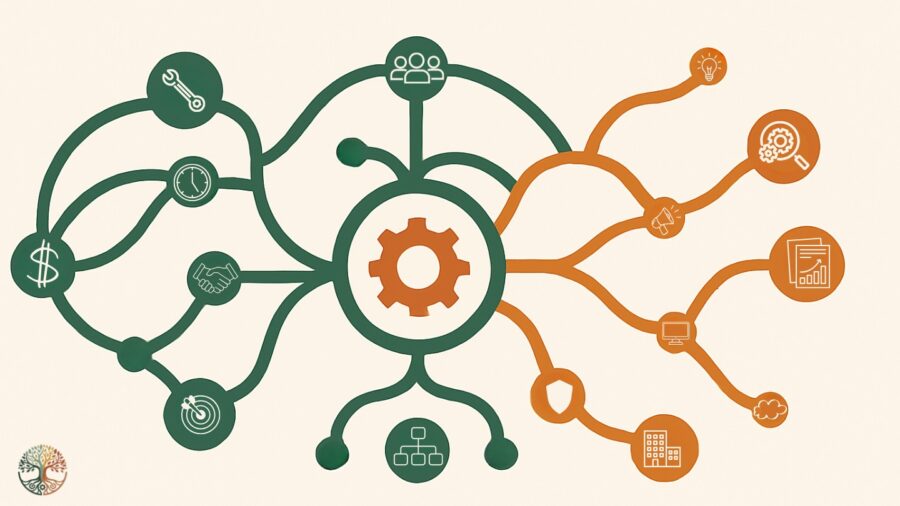
Social change organizations and small nonprofits often exist in a state of resistance—pushing back against systemic oppression while trying to build new worlds. However, when we focus entirely on the external fight, we often neglect the internal soil.
“Operational gaps” in the corporate world usually mean a loss of profit. In our work, these gaps represent fractures in our integrity: the distance between the liberatory values we preach to the world and the reality of how we treat each other inside the organization.
Diagnosing these fractures isn’t about policing productivity; it is an act of collective care. It is about ensuring our internal systems are robust enough to hold the weight of our vision without crushing the people doing the work.
Redefining Operational Gaps: The Alignment Check
In a decolonial framework, an operational gap is not just a “process failure”—it is a misalignment. It happens when our daily practices (how we meet, how we decide, how we rest) inadvertently replicate the very systems of urgency, hierarchy, and extraction we claim to dismantle.
For small organizations, these gaps often manifest as the “Scarcity Trap”—the belief that we must work until exhaustion because resources are finite. When we lack shared agreements or clear containers for our work, we rely on individual heroism rather than collective infrastructure.
Listening to the Body of the Organization: Signs of Fracture
Just as our physical bodies signal distress before a collapse, our organizations give us warning signs. We must move away from viewing these signs as “performance issues” and start viewing them as structural feedback.
Transactional Relationships: Do interactions with community members or staff feel extractive? If we are rushing through relationships to meet grant deliverables, we have lost our “power with” orientation.
The Cult of Urgency: Are deadlines consistently overriding intention? If “everything is a priority,” nothing is. This is a hallmark of white supremacy culture that keeps us reacting rather than responding with intuition and intentionality .
Extraction and Burnout: Is the work fueled by the martyrdom of your staff? If your team is exhausted, sick, or cynical, the organization is extracting labor rather than regenerating power.
The “Founder’s Trap”: Are decisions bottlenecked at the top? When information is hoarded (even unintentionally) and roles are murky, power is concentrated rather than distributed.
Root Causes: Why We Drift
Nonprofits cWe often blame these issues on “lack of funding,” but the roots often go deeper into our design:
- Replicating Hierarchy: We inadvertently copy-paste corporate pyramid structures that isolate leadership and disempower staff, rather than building circular or holacratic decision-making models.
- Lack of Shared Agreements: Without clear “Standard Operating Procedures” (or more accurately, Community Agreements), we rely on unspoken expectations. This disproportionately harms those who do not share the dominant cultural background of leadership.
- Mission Creep: In an effort to chase funding, we stretch our roots too thin, disconnecting from our core purpose and diluting our impact.
Insight: A lack of structure is not freedom; it is often just hidden hierarchy. Clear processes create safety and equity.
The Cost of Ignoring the Cracks
If we do not tend to these internal fractures, the consequences are severe—not just for the “business,” but for the movement.
Movement Stagnation: When we are stuck in administrative chaos, we lose the capacity to dream, build, and pivot to be in tune with the community’s momentum.
Reproducing Harm: While harm affects everyone, it’s important to understand that the intensity is often unequally distributed. An unregulated internal culture often harms Black, Indigenous, and racialized staff first.
Loss of Trust: If our internal reality doesn’t match our external messaging, the community will sense the dissonance. Trust is our only real “currency;” losing it is fatal.

Strategies for Collective Sensing and Repair
Diagnosing these gaps requires shifting from “auditing” (a punitive mindset) to “sensing” (a restorative mindset). Here is how to assess your organization with an anti-oppressive lens:
1. Internal Reflection Circles (The Self-Audit)
Instead of a top-down review, facilitate spaces for honest reflection. Move beyond “Did we hit our numbers?” to “Did we live our values?”
- Tool: Use a “rubric of alignment” to check current practices against your stated values of equity and justice.
- Review your financial flow: Does your budget reflect your morality?
- Review your decision-making: Who is at the table, and who is eating?
2. Humanizing Data
Data is not just spreadsheets; stories are data. While quantitative metrics (funding levels, retention) matter, prioritize qualitative “sensing.”
- Use data to advocate for rest and capacity, not just output.
- Track the sentiment of your team, not just their hours.
- Visualize the flow of resources to see where energy is getting stuck or hoarded.
3. Accountability to the Ecosystem
Move from extracting feedback to building accountability. Don’t just survey your community; engage them in the design of the solution and trust that they are the experts who will lead the way.
This feedback is the truest diagnostic tool for checking if you are actually operating with the community at the center of everything you do or just serving the nonprofit industrial complex.
Ask the people you work with: “Where are we difficult to access? Where do we feel bureaucratic rather than human?”
4. Seeking Wise Counsel (Third-Party Support)
Sometimes we are too close to the work to see the patterns. Engaging external facilitators or consultants doesn’t mean bringing in “corporate” energy. Look for movement-aligned partners who understand anti-oppression and use collective, restorative, and decolonial frameworks.
- They can provide a safe container for difficult conversations about trust and power dynamics that staff may feel unsafe raising internally.
- External eyes can help identify where “institutional habits” are blocking “movement flow.”
A Call to Regenerative Action
Diagnosing operational gaps is not about becoming a polished machine; it is about becoming a healthy ecosystem. By identifying where our practices contradict our values, we can build an organization that is not only sustainable but truly liberatory.
The work isn’t just what we do—it is how we do it.
Looking for support for your organization’s alignment?
Rooted Ops Consulting supports mission-driven organization optimize their operations using rooted approaches and with communities and the people behind the work in mind. From helping you draft a “Community Agreement” framework, in lieu of traditional SOPs, focusing on shared power, clear decision-making, and conflict transformation to identifying efficiency gaps and helping you bring a more human and functional structure to your organization—where would you like to start? Get in touch!
Leave a Reply