
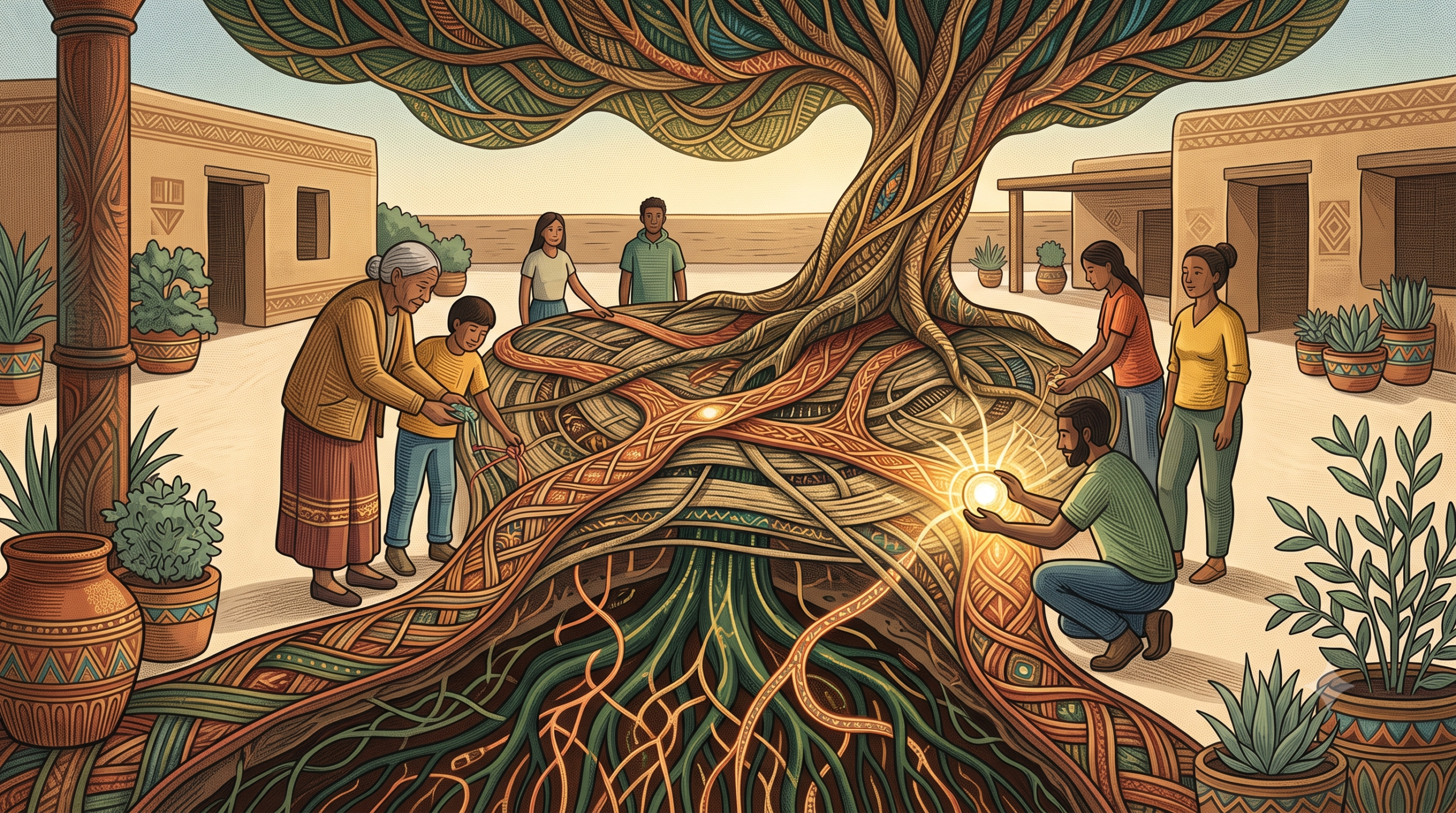
Grow Without Losing Your Soul
If you’ve ever been part of a grassroots movement that started to grow, you know the feeling. What began as late-night living room meetings and community solidarity suddenly requires bank accounts, bylaws submissions, and grant proposals.
The necessity of this transition is undeniable. To scale your impact, secure sustainable funding, and outlive your founding members, you need structure. But this growth phase carries a dangerous paradox. It is often thought that the mechanism to sustain an organization necessitates bureaucracy, professionalization, and chasing institutional funding. This very mechanism introduced to sustain your work ends up threatening to alienate you from the community you started out fighting for.
Critical scholars call this getting sucked into the “Non-Profit Industrial Complex” or the “NGOization” of a movement. Most dangerously though, it happens incrementally. You tweak one program to fit a funder’s grant requirements. You adopt a top-down corporate hierarchy because your board believes it’s good for risk mitigation. Slowly, the focus shifts from radical, systemic change to mere organizational survival and managing symptoms.
But institutionalization doesn’t have to mean selling out. By intentionally designing your operations, governance, and culture, you can build an organization that is both highly efficient and fiercely rooted in its original values.
How? Here are four deep insights from movements that successfully scaled without losing their soul.
1. Structure Doesn’t Have to Mean Pyramids
A fundamental trap of scaling is assuming that “getting organized” means adopting a traditional, top-down corporate hierarchy. Grassroots movements naturally resist this, but remaining entirely structureless often leads to hidden power dynamics and operational paralysis.
The alternative? Options abound! From Shared Governance to Collective Leadership to Indigenous Models. You need to do your research and find the model that works best for you context, culture, and community. Instead of a pyramid, imagine your organization as a series of interconnected circles where authority is decentralized. Teams (or “circles”) have full autonomy over their specific domains. Decisions are made by a decision-making process that is agreed up on amongst the team members. This ensures rapid decision-making while safeguarding everyone’s voice.
Coupled with decolonial leadership modalities—which prioritize Indigenous ways and knowledge, community self-determination, and the active dismantling of colonial hierarchies and inherited power structures—your internal governance can actively mirror the equity and liberation you are fighting for in the world.
2. Ditch Punitive HR for Restorative Justice & Enabling Leadership
Bluntly said, traditional Human Resources departments are designed to protect the institution from liability. When conflict arises, they rely on punitive frameworks: warnings, suspensions, and terminations. If you are an organization advocating for social justice externally, replicating these carceral, punishing systems inherited from an essentially oppressive paradigm, internally creates massive cognitive dissonance.
Rooted organizations use alternative approaches. In Restorative Justice, when harm occurs or conflict arises, the focus shifts from “Who broke the rule and how do we punish them?” to “Who was harmed, what are their needs, and whose obligation is it to repair it?” In a Leadership Empowerment approach, when a mistake occurs, the question isn’t who’s to blame but rather how can we coach this person to learn from their mistake and become a better leader as a result.
By integrating coaching, circles, and peer facilitation into your daily operations, you build a culture of deep psychological safety. When people aren’t afraid of making mistakes, it drastically reduces burnout and turnover and promotes a healthy working culture, keeping your team energized for the mission and open to learning.
3. Shift from “Fixing” to “Facilitating”
As organizations professionalize, it’s easy to start viewing communities through a clinical lens of deficits—conducting “needs assessments” to figure out what a neighborhood lacks so your organization can swoop in and fix it. Whether intentionally or unintentionally, this treats communities as passive recipients and fosters dependency.
To stay rooted, consider an Asset-Based Community Development (ABCD). ABCD completely flips the script. It assumes that every community already has the assets, skills, and networks required to thrive. Rather than asking “What’s wrong here?”, you ask “What works, and how can we connect these existing assets to build more power?”
The organization’s role shifts from a provider of services to a facilitator and enabler of existing community power. Programs are co-created with communities, ensuring that your growth is inextricably linked to their empowerment.
4. Break the Logframe: Redefine Accountability
Perhaps the biggest driver of “mission drift” is how we measure success and who we report it to. Traditional non-profit and NGO operations are trapped in transactional accountability: proving to distant funders that every dollar produced a specific, linear output. This stifles innovation and forces organizations to chase short-term, easily measurable wins over messy, long-term, and radical systems change.
Resilient organizations push back by championing Relational Accountability and downward accountability to the community. They utilize evaluation methods like the Most Significant Change (MSC) technique or Narrative-based Change. Instead of relying purely on rigid quantitative indicators, for example, MSC involves systematically collecting stories of change directly from program participants. The community and the staff collaboratively analyze these stories to determine what actual, meaningful impact looks like.
When your definition of success is co-authored by the people you serve, rather than dictated by a distant grantmaker, you embed accountability directly into the community fabric and your mission stays rooted in communities.
The Takeaway
Scaling a grassroots movement is hard, but giving up your values is not inevitable.
Institutionalization is a tool. When you consciously align your internal operations, governance, HR, evaluation metrics and even “risk management” with your grassroots values, you stop merely managing the symptoms of injustice and build a durable vehicle for real, systemic transformation that continues to be a force of your community.
Leave a Reply