
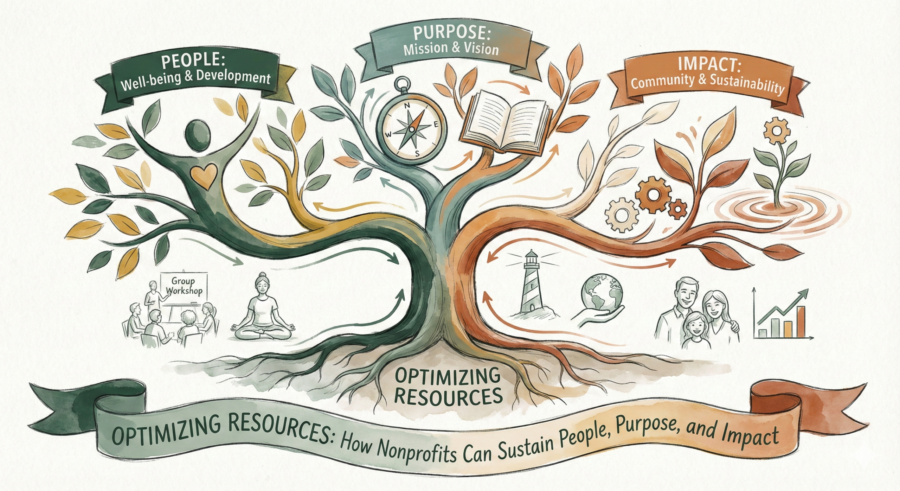
Nonprofit culture often pushes urgency, exhaustion, and constant output. But movements aren’t sustained by “doing more”—they’re sustained by caring for people, protecting energy, and building systems that make organizing livable. Preserving resources is political. When our people burn out, systems collapse, campaigns stall, and movement knowledge disappears. Preserving resources is not scarcity—it’s strategy for longevity and power.
Nonprofits that want to align with movement values can start by defining preserving resources as rejecting extractive practices. This also extends to rethinking how we do the work, and whether we center wellbeing as an organizational infrastructure. This is not self-care as branding—it’s collective care embedded into how we operate and how we distribute power.
Resource Preservation Means Protecting People First
Budgets, policies, and grants matter—but none of that is sustainable if staff, organizers, volunteers, and community members are exhausted. Preservation means:
- slowing down when capacity is low
- setting boundaries even when funders push urgency
- sharing, instead of concentrating, responsibility so that we build leadership
- allowing organizers to rest without fear of consequences
Movements die when burnout becomes normalized. They grow when we treat rest, healing, and time as movement resources—not luxuries.
Rejecting Grind Culture in the Name of “Impact”
For too long, nonprofits celebrated overwork as commitment. We cannot build community power on bodies that are collapsing. A resource-preserving practice looks like:
- ending email expectations outside normal hours
- no-meeting weeks after campaign cycles
- restorative leave that doesn’t require emotional justification
- creating a culture that respects, rather than frowns upon, people when they say “I can’t take that on right now”
Normalizing urgency concentrates decision-making at the top. When we slow down, organizing becomes collective again.
Functional Systems That Reduce Emotional Labor
Bureaucracy wastes the most important resource we have: creative energy. Streamlined systems are not corporate—they are movement-strategic.
Functional systems preserve resources by reducing confusion, decision bottlenecks, emotional strain, and duplicated labor. This means:
- clean onboarding processes
- clear roles that don’t shift every other day
- accessible documentation (not gatekept knowledge)
- shared calendars and openly available plans
When systems are predictable, staff don’t waste energy improvising survival strategies every day. They focus on what matters—the mission and the people we are accountable to.
Unburdening Staff from Bureaucracy
Bureaucracy often emerges as control—not clarity. In movement aligned spaces, resource-preserving systems look like:
- short approval chains
- delegated decision power
- minimal reporting tasks
- no performative paperwork
People closest to the work should not spend more time tracking it than doing it.
Distributing Leadership to Prevent Burnout
Burnout is often treated individually—but it’s a structural outcome of hoarding responsibility. When leadership is shared, sustainability comes naturally and collective care becomes a cornerstone for building resilience. In organizations, this looks like:
- training constituency leaders, not just staff
- building teams instead of lone “program leads”
- rotating facilitation, not defaulting to the same person
- acknowledging capacity realistically
Movements have always been strongest when leadership is networked rather than centralized. Preserving resources requires accepting that staff do not hold movement wisdom alone—communities do.
Resource Preservation as Boundary-Setting With Funders
Funders often introduce urgency, deliverable-based timelines, and unrealistic expectations. Preserving resources means saying:
- we won’t run programs without adequate staffing
- co-creating strategies from the ground up
- timelines must align with community pace
- reporting requirements must be based on trust and not compromise our community relationships
- we cannot sustain burnout as a deliverable
When nonprofits set boundaries, funders must adjust—not communities.
Advancing movement work in nonprofits means refusing to stretch people into burnout to secure funding stability.
Preservation Through Culture, Not Policy Documents
Cultures of sustainability are built day-by-day:
- leaders modeling rest
- team agreements rooted in reciprocity, relationships, and care
- celebrating slow-burn wins, not just explosive campaigns
- checking in on physical, mental, and emotional capacity and wellbeing—not just deadlines
When we normalize slowness, consent, accountability, and care, our human and material capacities expand rather than shrink.
Resource Preservation Is Power Preservation
Movements succeed when organizers are healthy enough to stay in the fight.
Sustaining work means:
- keeping people informed, not overwhelmed
- retaining institutional knowledge instead of cycling through burned-out staff
- building systems informed by and useful to communities
- reducing turnover so relationships endure
- structuring work around organizing momentum
When we preserve people, we preserve power.
That’s why, when we move at the pace of relationship rather than urgency, we build movements that last—not just projects that conclude.
Resource preservation, at its core, is not self-care—it is movement infrastructure. It is how we sustain campaigns, leaders, and communities across years and generations.
And that is how we build the foundations to win lasting change.

Leave a Reply